Maine squeeze
It’s a sticky, steamy late morning in the middle of August as Dawn and I queue up out in front of Holy Donut. By the time it’s time to order, I’ve written at least the chorus of a Weird Al-style parody of Dio’s Holy Diver. It’s about donuts. It’s all about donuts today. Less than halfway through the mile-long walk back to our BnB, we pull over in a park near campus to sample the sacred, dense, gooey goodness. The donuts were worth the wait, and so far, Portland, Maine seems worth the three-hour drive from Connecticut. Lobsters. Lighthouses. What’s not to love?
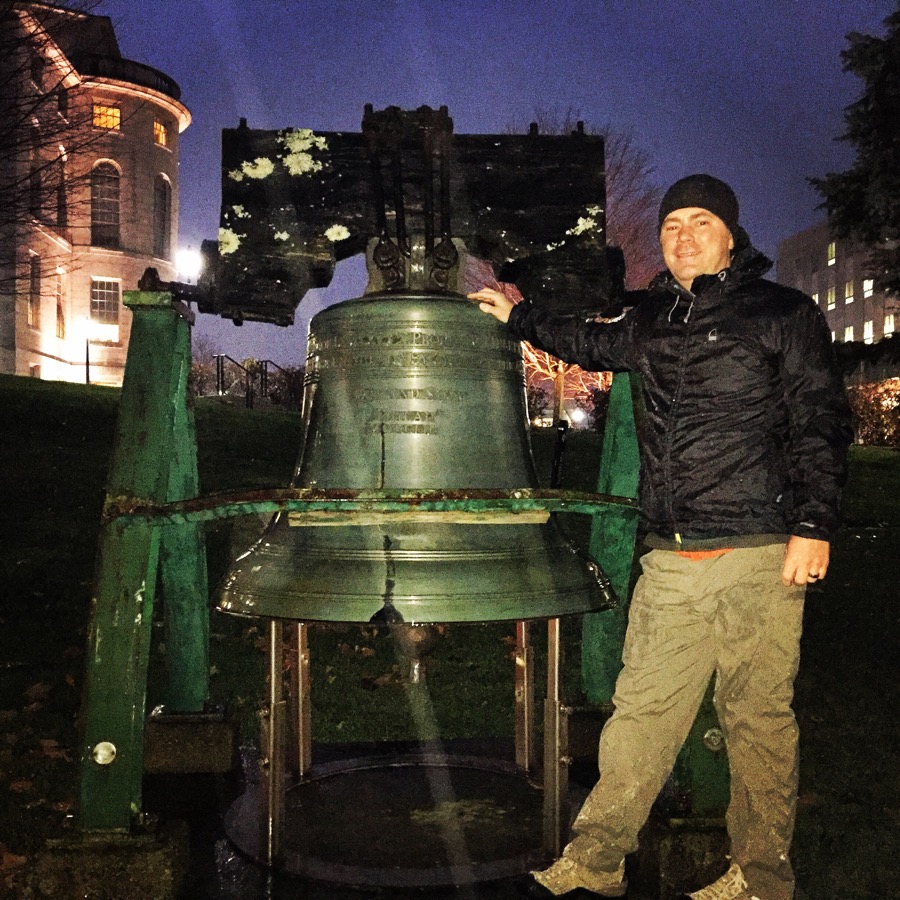
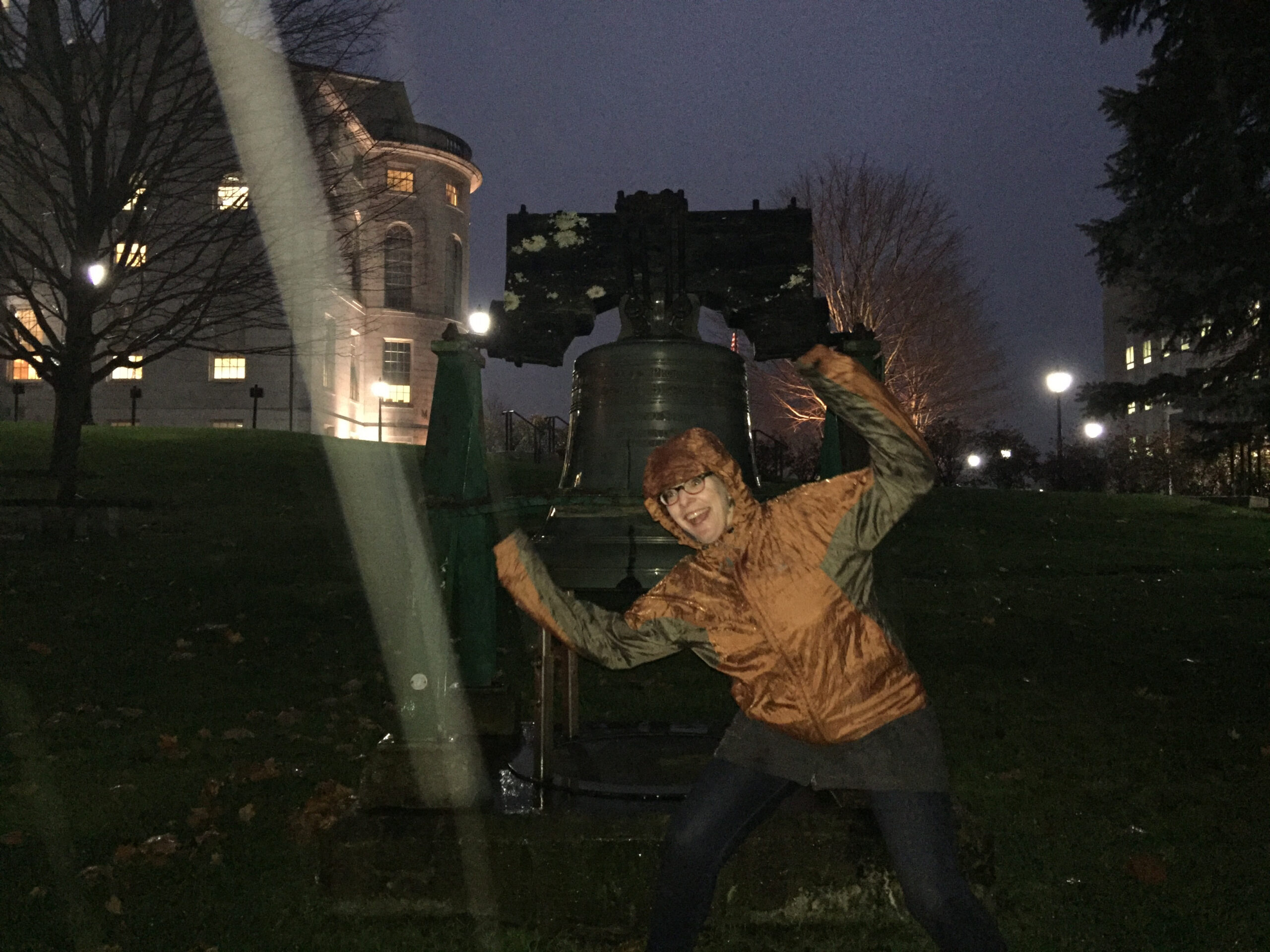
Our only other time in the state was on our epic, 9-day, 7-bell, Midatlantic tour in 2015. Maine was bell 5 on day 4 — we stayed just long enough for some rainy photos, a lobster roll and a good night’s sleep before heading to Boston — not sufficient time to form an opinion on this seemingly lovely state.
A quiet life
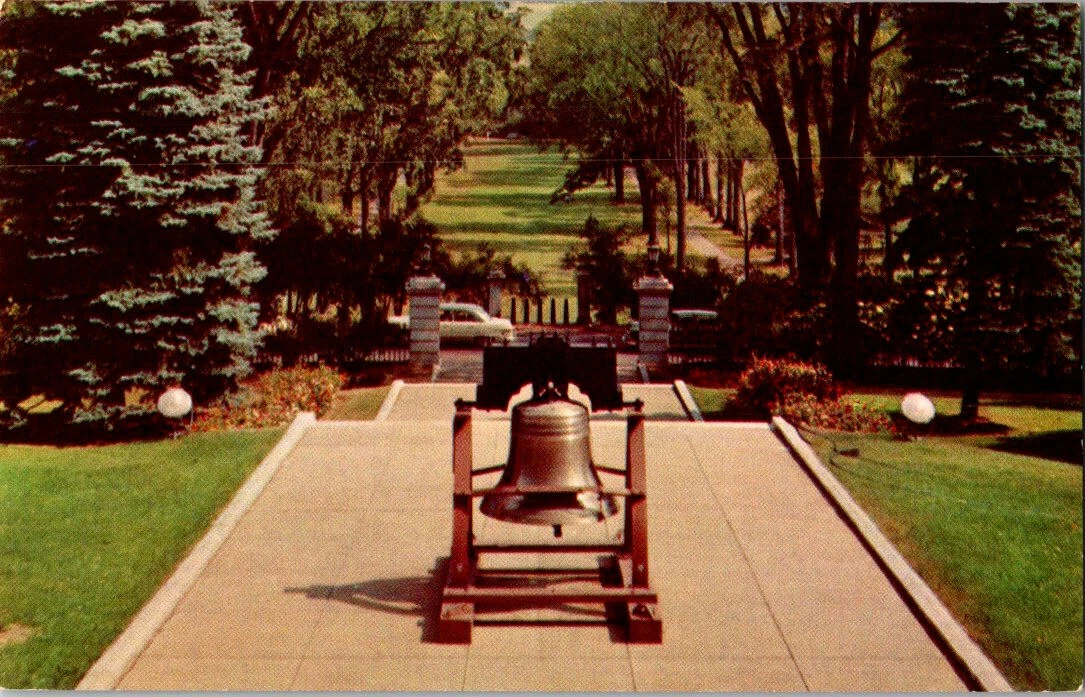
As Liberty Bell replicas go, Maine’s has lived a good, quiet, respectable life. Seventy-six years on, it still has all its original parts, and some extra support. Unlike many of its bronze brethren, the replica’s never been thrown into storage for decades, treated as a monumental hot potato, sent back out on tour for the Bicentennial or hastily restored for the Semiquincentennial.
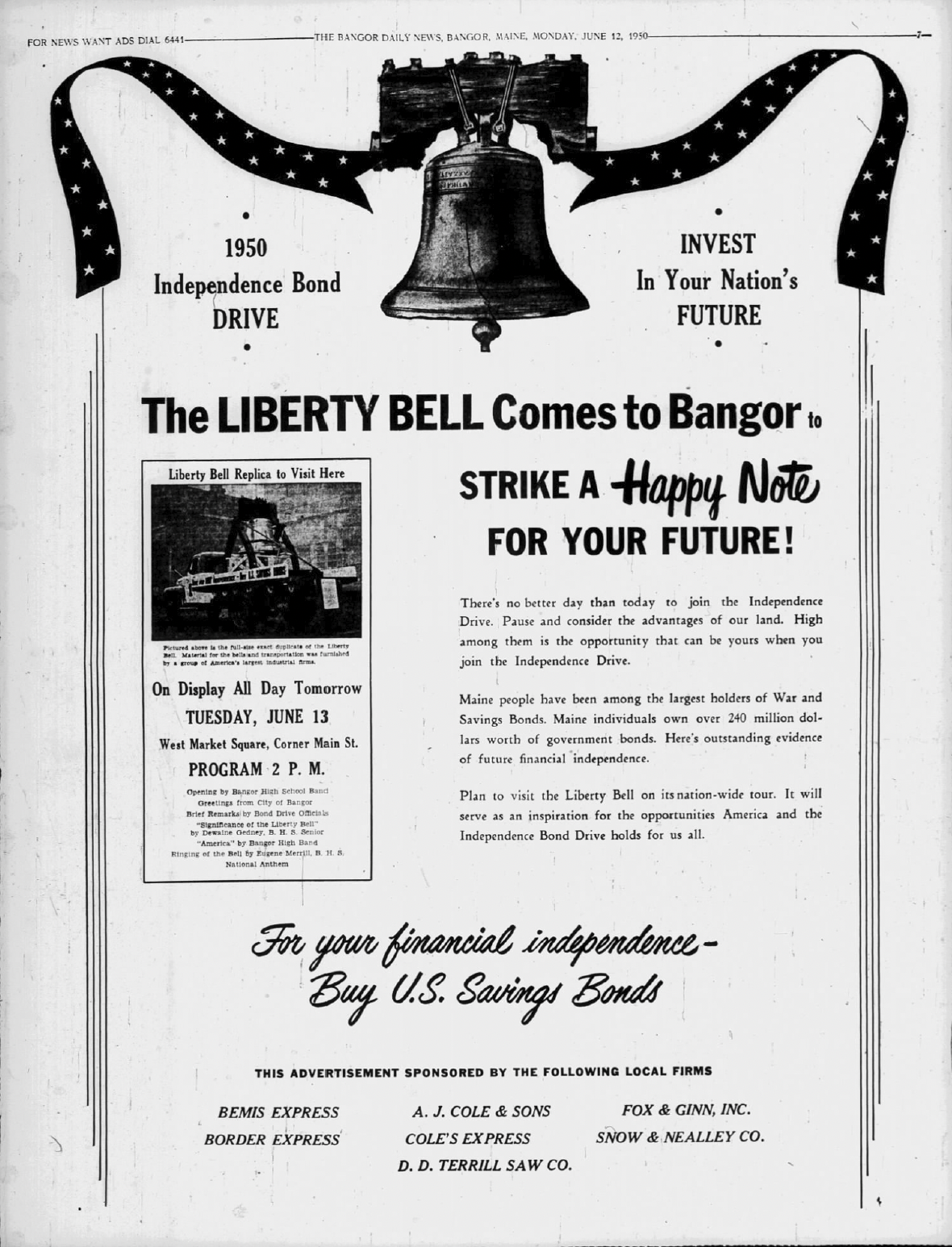
During the 1950 Savings bond drive, the bell performed admirably, touring more than 100 cities and towns over a truncated 30-day campaign. The state sold 116.5% of its quota, raking in $2,950,945 and ranking 12th overall nationwide. Dozens (maybe hundreds?) of bell hunters have stood for snapshots on the Capitol lawn next to the Maine Liberty Bell. It’s clocked a dependably unremarkable existence, save for one piece of journalism and one piece of vandalism.
Easter egg
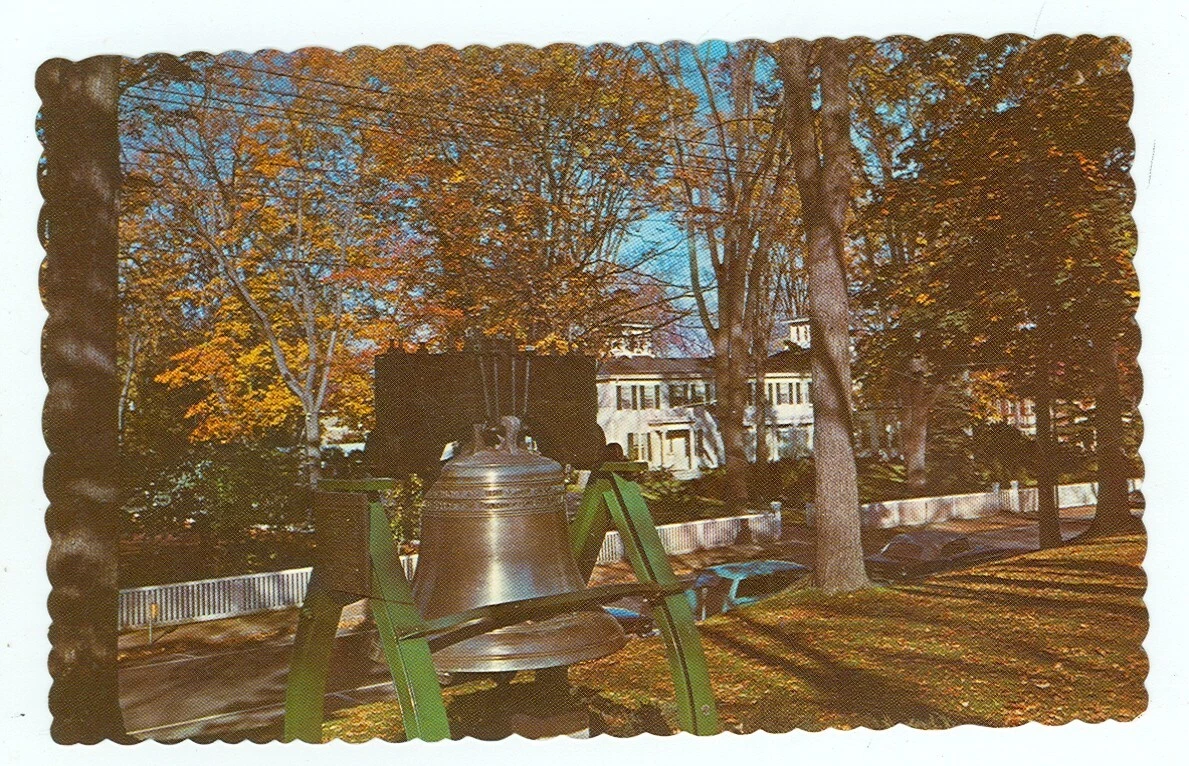
Walking to Mass at Saint Mary’s in their shiniest Sunday shoes, the good people of Augusta file past the Capitol on this sunny, cool, 1958 Easter morning. The congregants notice something different about the state’s newest attraction. Gone is the shiny-copper-penny, pre-patina glow of an 8-year-old monument. Instead, the bell boasts a bright blue hue — an unexpected Easter egg of monumental proportions. The midnight pranksters seem to have used the entire gallon and left no evidence behind, other than the blue bell, that is. Still tacky to the touch, the paint appears to have been applied thoroughly and hastily.
Capitol custodians strip and shine the Liberty Bell back to ship shape in no time, and the vandals are never found. Whether any concerted effort was spent on their capture is lost to history.
A man for all seasons
Five years later, the Maine Liberty Bell catches the eye of another passerby and stops him dead in his tracks with deja-vu. If Horatio Tobey Mooers was a fictional character, the author would need to dial back his story by 50% to make it believable.
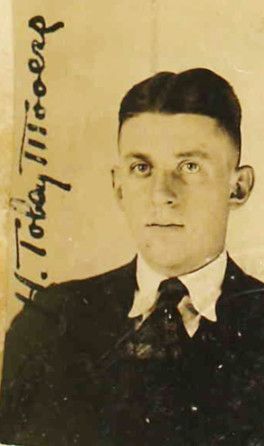
Here’s Horatio’s highlight reel: Born in Vassalboro, Maine, in 1894, Mooers entered the Great War on his 23rd birthday — a month before his country joined the effort — volunteering to serve as an ambulance driver on the front lines with the 127th Division French Infantry as its only foreign soldier. A mustard gas attack nearly killed him. He came home briefly, then returned to the front as a member of the U.S. Army. He served again in the Second World War. En route to a special mission in Madagascar, Mooers was captured by the Japanese in Manila along with 25 other servicemen. He described his treatment as a POW for 21 months as “fair,” during which time he wrote a novel in French based on his experience. He was freed in a prisoner swap in 1943. Between wars and beyond, he served diplomatic roles in Antwerp, Brussels, Edinburgh, Horta, Lisbon, Turin, Quebec City, Toronto, St. John’s, Mexicali, Tijuana, Port-au-Prince, Cherbourg and Lyon.
So, dear reader, I will leave Maine for now, and I will leave you with the musings of the incomparable Horatio Tobey Mooers, in their entirety,1 as originally published by the Lewiston Sun Journal Magazine on August 28, 1963.

Augusta’s Liberty Bell Replica Was Cast In Old French Foundry
By H. T. Mooers (Consul General, Retired)
While in Maine last September, I happened to drive through Augusta and past the State House on State St. I liked the broad granite steps that rose leisurely to the Greecian-style building above and the soft glow of the green metal dome. Golden leaves, caught in a playful breeze, danced along the curb as I entered a parking space close by. Then I made my way slowly to the upper grounds and, when half-way there, a young couple hastening past me in their descent, said something about “a bell that stopped traffic”. A few steps more, and I knew what they meant. Directly in my path rose a full-sized, bronze replica of the Philadelphia Liberty Bell.
The historic fracture had not been attempted in the casting but had been simulated thereafter by a narrow brush stroke in white enamel. A margin of black set it in striking relief.
Augusta
Suddenly, I knew that 10 years before, in France, I had either seen and heard that very bell or one of its 52 identical sisters. Over there, none had been locked in chains but the one now before me was pressed solidly to earth by V-shaped iron braces, coated with reddish-brown paint the better to withstand a New England winter. The wooden yoke or top section I knew to be of rugged oak from the forests of Haute Savoie and it had been artificially “seasoned” to give the appearance of age. Superficial “scars” and “cracks” had been deftly burned into the surface. The eight U-shaped bolts joining the yoke to the bell proper were hand-forged, perfect reproductions of Revere’s 18th century orginals. Steel armatures, supplemented by two chains apparently without beginning or end, pinned the great, silent bell to earth. Prometheus could hardly have been more solidly bound.
Indeed, it seemed a great pity that so splendid a piece of cast metal, conceived to fill the heavens with joyous sound, should have been so definitely grounded and muzzled! There was a sort of resolute, deep-dyed, dead-end scheme of utter finality about the whole thing that I could not accept.
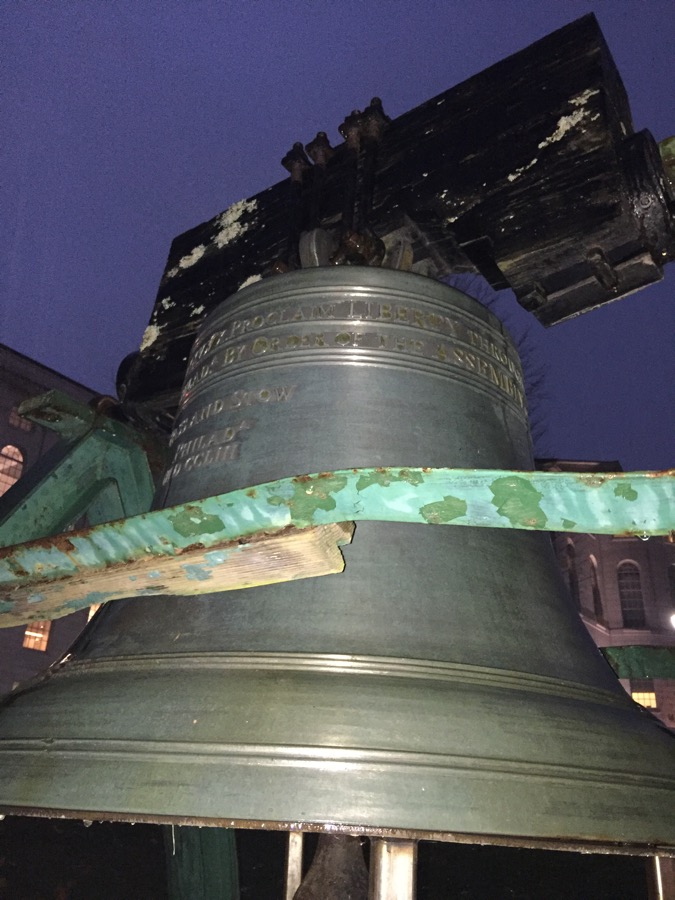
On one side was bolted a plate bearing a lengthy inscription, surrounded by 48 stars. As the inscription was somewhat more than I could carry in my head, I drew forth a pen and searched my pockets for a piece of paper. Finding none, I ascended the remaining steps and entered the Capitol. The high walls of the entrance hall were hung with large and impressive paintings of former governors and Justices of the Supreme Court. The floor was highly polished and an air of dignified orderliness lay all about. To the right, a high-ceilinged passage led to the library, where a young lady in a gray dress and red shoes was operating an adding machine. She promptly got up and asked me if she could be of assistance.
The Inscription
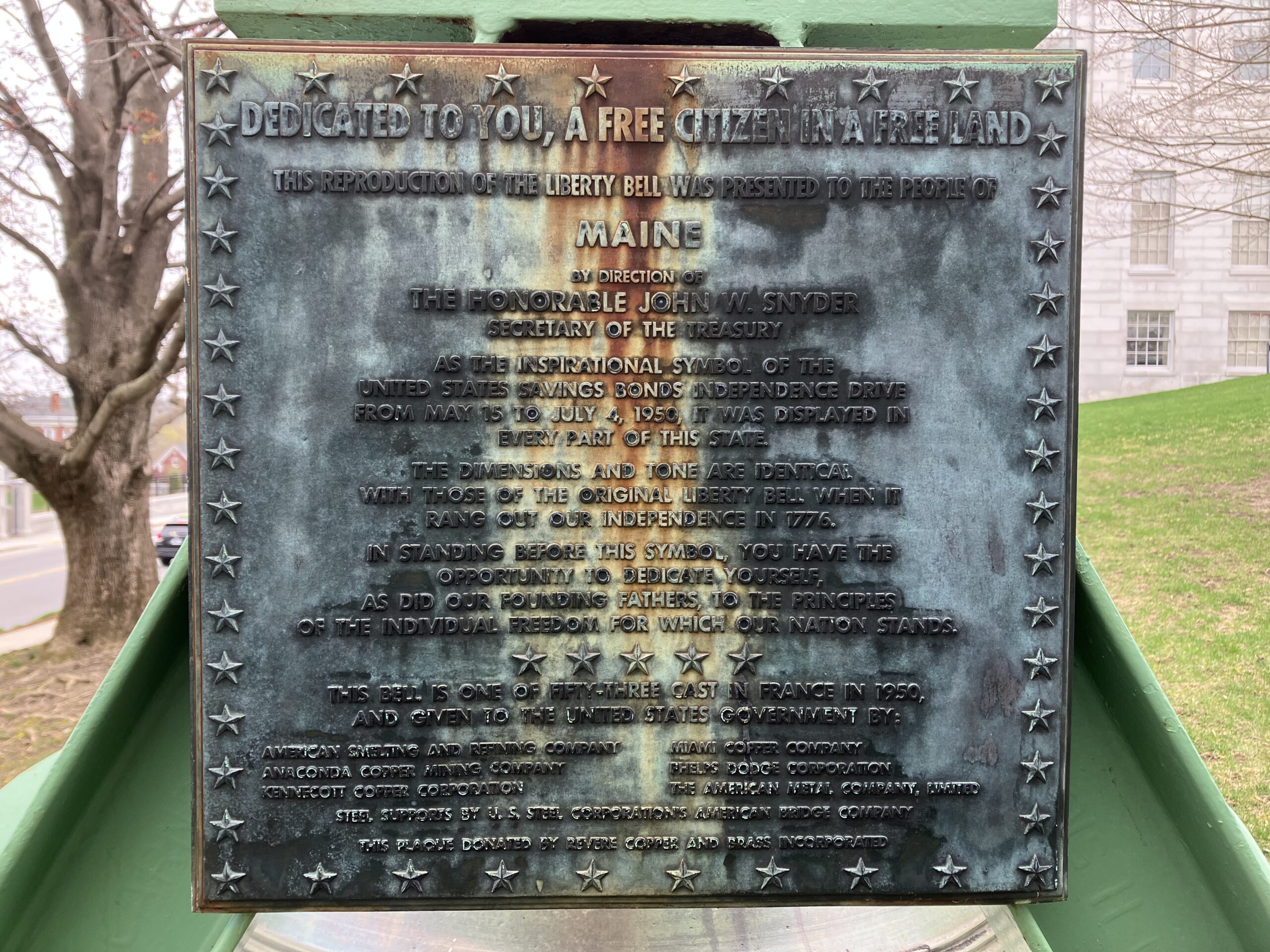
I replied that a sheet of paper would be welcome, as I wished to copy the inscription on the Liberty Bell. I thanked her and returned to the bell. The inscription follows:
“Dedicated to you, a free citizen in a free land. This reproduction of the liberty bell was presented to the people of Maine by direction of the honorable John W. Snyder Secretary of the Treasury as the inspirational symbol of the United States savings bond independence drive. From May 15 to July 4, 1950, it was displayed in every part of the state. The dimensions and tone are identical with those of the original bell when it rang out our independence in 1776. In standing before the symbol, you have the opportunity to dedicate yourself, as did our founding freedom for which our nation stands.
“This bell is of 53 cast in France in 1950 and given to the United States government by:
American Smelting and Refining Company, Miami Copper Company, Anaconda Copper Mining Company, Phelps Dodge Corporation, Kennecott Copper Corporation, The American Metal Company, steel supports by United States Steel Corporation’s, American Bridge Company.
“This plaque donated by Revere Copper and Brass Incorporated.”
I read slowly and comfortably down to the five brass stars.
Then I noted with interest the next line to the effect that the bell was one of 53 cast in France.
I wanted to hear the tone of the bell and tried to coax an indication of its volume with my bare knuckles but to no avail; then I tapped daringly with my ring but again there was no response of any significance. Tightly wrapped in its armatures and chains, it lay sullen and mute. I wondered if, by virtue of long inactivity, a bell would ‘die’?
In March of 1950, I think it was the 17th of that stormy month, John Brown, one of our Cultural Attaches then at the Embassy in Paris, had explained over the telephone, speaking to me at the Consulate in Lyon, that he thought we should go down to the Paccard foundry in Annecy for the informal ceremony which Monsieur Paccard wanted to take place the coming Thursday. On that day, 53 replicas of the Liberty Bell were to be transported par camion, two to a truck, to Marseille for shipment to New York.
Annecy was a picturesque and happy little mountain city on the clean shores of one of France’s most poetic lakes. We looked forward to the trip, and the following week Brown drove down to Lyon, bringing an official photographer with him, and the three of us set out for Annecy.
We skirted the lower reaches of the lake and ended suddenly in the front yard of Monsieur Paccard’s fonderie at about 11 o’clock that forenoon. This ancient establishment, which enjoys a worldwide reputation, sits back a fair stone’s throw from the shore and, like all foundries the world over, appears to have no relation whatever to time or events. Just how old it is, I do not know, but it has been casting great bells for many years.
Unimpressive
The thick walls are wholly devoid of personality, style or color and the windows are few, sooty and forbidding on rainy days. We found the interior veiled in obscurity on entering, but were glad to be out of the cold rain that had fallen ever since Lyon. It was evident that work in the plant was already over for that day. Two workmen were conversing idly in a corner. Little else than scattered heaps of what appeared to be sand or clay, several deep pits and two furnaces—one still smouldering — was to be seen.
There were, however, a number of stout, wooden pulleys spaced regularly overhead, threaded with coarse rope well soiled by much handling. Suddenly we heard our names called and, turning, saw Monsieur Paccard advancing to greet us, smiling, his hand extended. He looked no more than 40 and obviously abounded in energy and cheerfulness. He was rather thin, of medium stature and his eyes were blue. He regretted that he had not been able to welcome us at the main entrance; he had been at the Under-Prefect’s—hoping that Monsieur le Sous-Prefet could find time to assist at the little ceremony to be given presently in honor of the completion of the bells. Monsieur Paccard confided that he had had the Devil’s own time getting the bells completed on schedule, but, his men turned the trick. Should we perhaps go and see the bells right now?
Passing under a wide arch to an inner and much larger floor level we came upon a heroic V-for-Victory formation of huge bells, each a perfect replica of its neighbor.
Paccard explained that today was a holiday for his men although they would all show up presently for the little ceremony. Nearly all employees had been with him for a considerable period of time; some had worked for his father, now deceased. It was a sort of “grande famille.” There never had been any labor troubles and he saw no reason why there ever should be. Each man was a master of his particular job and proud of his individual responsibility. Bell makers, genuine ones, usually didn’t just “happen”; nearly always they were, in one way or another, born to the job and stayed with it.
One Knows — Until
In bell making, one never knew what the tone would be until the great “vase” had thoroughly cooled. Then, if it rang “faux” it was a complete failure unless perchance there might be a way of making it ring “true.” Sometimes the “voice” and pitch could be altered merely by the stroke of a file applied to the interior; a bit off here, a bit off there as one’s ear directed. One must have an ear sharply atuned to all combinations of metallic sounds.
Under the blow of the bell’s tongue or clapper, a giant wave of totally discordant vibrations was instantly created. These swelled, like mad souls, up and over the bell’s lip and only then,—assuming that the casting had been a success,—could these “frantic voices” unite in a single, harmonized tone; and in this fusion as by magic instantly purified, rendered musically true, softly, inspired. In consequence, perfection was the only permissible goal. There was no room for compromise. One had to have perfection 100 per cent—like Faith—or one had next to nothing, when it came to casting bells. Monsieur Paccard added that his father used to say that what leaps from the mouth of a great bell, when it has been successfully cast, is in reality “an heroic bouquet of sounds!!”
While he spoke, I noticed that many of his employees had returned.
They were quietly taking up what they doubtless thought to be casual positions beside the huge castings. I counted eight photographers already squaring away for the first shots. In Europe, mature or serious workmen like to be photographed in the company of the fruit of their labor.
This had been no one man’s achievement, and in the group photograph first to be taken, each man would appear with equal distinction. The bell that one employee leaned against was no more his than his neighbor’s. One older workman, his hair snow-white but his cheeks ruddy, removed his cap and stationed himself somewhat deferentially just back of a bell.
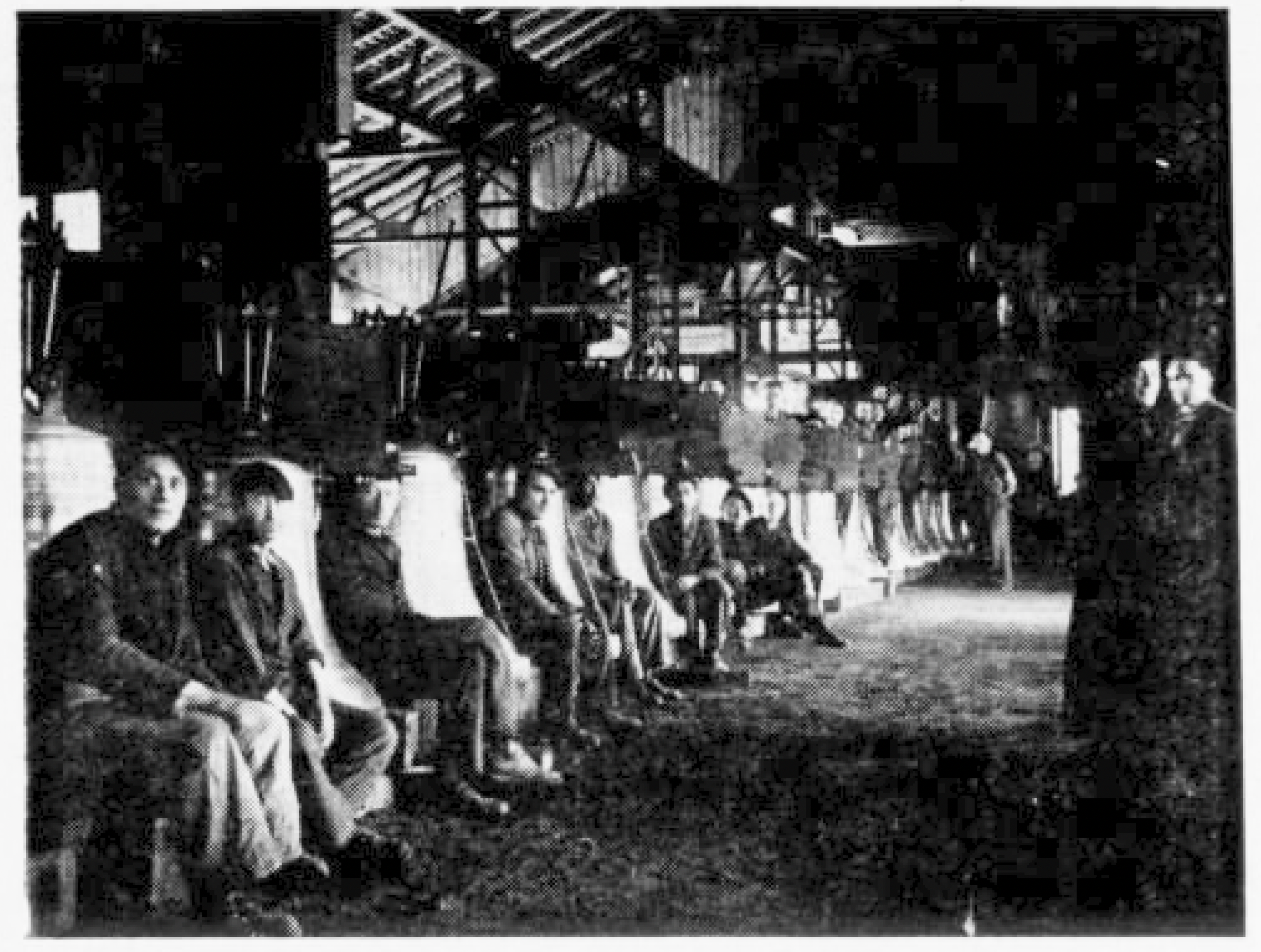
Another, somewhat younger, assumed a more nonchalant pose, crossing his arms, his head high, his beret at an angle. Yet another, well in the rear of the impressive formation, climbed with agility up a ladder and, well above his fellows, found his face lighted by a thin shaft of sunlight filtering through a murky window.
The Tone of Freedom
Monsieur Paccard showed himself in no haste to be photographed but eventually joined the group. This business over, he inquired if we would like to hear the real tone — “le ton reel” — of the Liberty Bell? We answered that we would indeed. He signalled to a workman who stood near, saying that he believed we would like its “voice” even though to do it full justice, it should be suspended some distance over our heads and in the open air. The employee, with the aid of two others, quickly hoisted one of the bells by means of a pulley and tackle, and, at the end of a long cord, slowly and carefully, swung the bell vigorously.
It Had Performed Well
Of course neither Brown nor I had ever heard the real Liberty Bell. In all probability, we never would. Yet, as I think back, some way I am almost sure that we did hear it that day. Coming swiftly to life, its great tone leaping among the rafters, crashing our ears with its power, I seemed to understand in some part what those who heard it long years ago had felt and thought—and dreamed.
Exultation, newly acquired strength, pride, fear, hope and prayer; magically, some way it was brought back in all its grandeur and integrity. Then the ringer dropped the cord and the cry faded and was still. No thunderous challenge swam longer over our heads, not the faintest echo remained, and yet nothing had gone from that room!
Monsieur Paccard looked up at us and nodded. The great bell had said all that was called for, and had said it far better than we could have done. Then he gave a brief order and I caught the word “champagne.” Townspeople were coming in by two’s and three’s. There was already the community Curate — “Monsieur le Cure” — a young and fair man of serious visage whose nose glasses seemed a trifle insecure, his sober raiment afforded some relief by the flowered dress and yellow kerchief of a stout and congenial housewife, with whom he entered into spirited conversation. As they spoke, the lady unsuccessfully restrained with concealed effort a small boy of six, holding him securely with her left hand while gesticulating with her right.
In no time at all, there were some 50 or 60 people in attendance, — all neighbors, it seemed, — who had dropped in for the little fete in honor of the bells. Several carried paper parcels holding small purchases that apparently had been made within the hour. Most everybody had come as he happened to be dressed, although two or three seemed to have read more protocol into Monsieur Paccard’s invitation than was intended and now, in more formal attire, appeared slightly ill at ease among the others.
Two younger employees brought forward a table, placed a large white cloth on it and then a hamper from which they removed a surprisingly large number of wine glasses. These they arranged neatly in rows of eight.
While the refreshments were being served, Monsieur Paccard volunteered a humorous aspect of the story of the bells; a few weeks back, he had been told over the trans-Atlantic telephone by some person of authority in Washington — he could not then recall the name — that his foundry was requested to cast an exact replica of the American Liberty Bell and that it must be completed by the close of the coming month of March. That was what Monsieur Paccard thought he had heard over the telephone. He accepted the order tentatively and a few days later confirmation as to the validity of the order was received from the American Embassy in Paris.
Sad Misunderstanding
Monsieur Paccard then flew to Philadelphia, photographed the bell, took its tone and measurements and hastened back to Annecy. In due course and well before the dead-line, the replica was completed and found accurate as to tone and measurement. Then he called “this gentlemen in America” advising him that the job was done. To Monsieur Paccard’s consternation, he found that there had been a “grosse erreur”; America had, in fact, ordered no less than 53 bells! Monsieur Paccard was implored immediately to cast the remaining 52 and complete the order by April 1st!
Paccard was speechless. He finally managed to tell “the official gentleman in America” that he had positively understood he was to make one bell. He had carefully and well made that one bell. Now, 52 others just like it were desired! La Fonderie Paccard enjoyed no assembly line in its production of bells as did American manufacturers of automobiles and washing machines. It appreciated the order, regretted the misunderstanding, and although he knew full-well that time and means at his disposition would render it impossible to complete so vast an order in so short a time, nevertheless before saying “no” definitely, he would talk the matter over with his personnel.
When he had called the men together that night, they had said “yes.” One of the oldest of his employees took the stand that it was too big an order to turn down “even if it couldn’t be done”, and suggested they work night shifts. Enthusiasm reigned unexpectedly and so the order was filled. Monsieur Paccard said he was moved not a little. They were brave boys and never let him down. He did not tell us the size of the bonus he accorded his men and we were too polite to ask.
An Eloquent Ceremony
To Monsieur le Cure went the first glass of champagne. The plump little lady in the flowered dress seemed somewhat resuscitated by hers. It took a while to serve everybody; the atmosphere was pleasingly unhurried, warm with lively conversation supplied by people who knew each other well and to whom bells were no particular novelty. Monsieur le Sous-Prefet finally appeared, officially apologetic and slightly aloof from Monsieur le Cure. We all touched glasses, first with Monsieur Paccard and then with the Under-Prefect and then with the Curate. All the while, everybody remained standing and thought nothing of it. Chairs had no place in a foundry. Good French wine on occasions did.
Then Monsieur Paccard made one of those quiet, informal and alert speeches that the French can do so well when they want to. He said he was naturally proud that his foundry should have been selected to make the replicas of a symbol dear not only to Americans but to all Frenchmen as well and emblematic of a cause in which his country had, in some measure, shared in the realization. The Marshall Plan joined hands for an instant with Lafayette and he deeply hoped that the great bells — which were already being loaded in trucks pulled up at the main entrance — would long be tokens of the friendship his country bore for ours. There was applause and then I knew it was up to me.
I thanked Monsieur Paccard for his kind words. France, long a friend of the United States, supplied us with many fine products. Many of these, in our opinion, could hardly be duplicated elsewhere. This time, however, the importations we were effecting from “la patrie de Monsieur Paccard” and from a very spot where we stood would be of quite different mold and conception, symbolic of man’s will for independence and liberty of belief and action. These imports might be the finest of them all. They would long remain treasured possessions of the land to which they now belonged. Vive la France!
Back To Work
There was the usual exchange of amiable phrases and good wishes. Guests took their leave. The refreshment table and all that had been on it was whisked away in a twinkling and the Under-Prefect’s black Renault was already well on its way back to the Prefecture.
A new contingent of workmen dressed for heavy labor, swarmed about the formation of Liberty Bells, shouting commands, and straining at pulleys. Chains came taut, clouds of sooty dust arose from the ancient floor while at the entrance the hoarse growl of heavy duty trucks filled the air as they vied for positions. We said our “goodbyes” to Monsieur Paccard and were again out in the clean air of Annecy’s narrow streets.
Before starting for home, Brown and I drove to a small restaurant in back of the City Hall where the food is plain but invariably good. We chose a table with a view of the lake. There was a red-checkered cloth and a wicker basket filled with freshly baked bread under a cotton napkin.
I asked Brown if he could still hear that bell. He said he could. It had been in existence hardly a week and was scarcely cold. ‘live,’ yet its voice was deep, strong and sure. Now for a note about this extraordinary concern itself:
This Remarkable Plant
The Paccard Foundry is the oldest and most important bell casting plant in France and one of the most (if not THE most) famous in the entire world — which has long been its market! It was established at Annecy-le-Vieux, Upper Savoy, France, more than a century and a half ago, by Antoine Paccard (in 1796). Today, it is operated under the firm name of “Les Fils de Georges Paccard” (“Sons of George Paccard”) Messrs Alfred, Henri and Jacques Paccard being the present owners.
More than 500 bells each year are shipped from this ancient establishment to all corners of the world; 60% of the production goes overseas. Canada, the U.S., and Africa are principal foreign outlets. In most all cases, bells are “tailor made” to meet the needs of the locality where used. To date, more than 40,000 have been cast and sold to such far-separated cities as Tokyo, New York, Vienna, Rouen, Montreal, Washington, Douai, etc. (Africa seems to eschew the “big” bells in favor of the smaller). The fame of the Paccard foundry appears to rest largely on its ability to “tune” (or “harmonize” the vibrations of their bells) to meet the required density of volume.
Monsieur Alfred Paccard points out to the author that people in well-removed areas of the world require different sound levels or “tuning” to suit their individual hearing needs and conceptions of proper or “good” sound.
He points out also that a carillon arrangement is the use of from 40 to 70 bells together.
Many years of study and patient experimentation have been required by these men and their loyal workers to acquire their present highly successful reputation in the world. Many of the workers have been long years at their jobs; not a few had fathers and even grandfathers who worked for “Monsieur Paccard.” Labor troubles are almost unheard of, so loyal is this highly specialized group of artisans and love of their work.
1 Beyond Mooers’ beautifully visual recollection of being “in the room where it happened” on the day the Liberty Bell set sail for America, his accounting contains details I’ve not heard elsewhere, including the story of Paccard flying to the U.S. to measure the OG Liberty Bell, thinking he was commissioned to cast just one.
Maine Liberty Bell replica
Location: North lawn of the State Capitol
230 State Street
Augusta, ME 04330
Serial Number: 40
Can I ring it? No. The clapper moves, but a metal attachment prevents contact with the bell.
Hours: 24/7 (outdoors)